
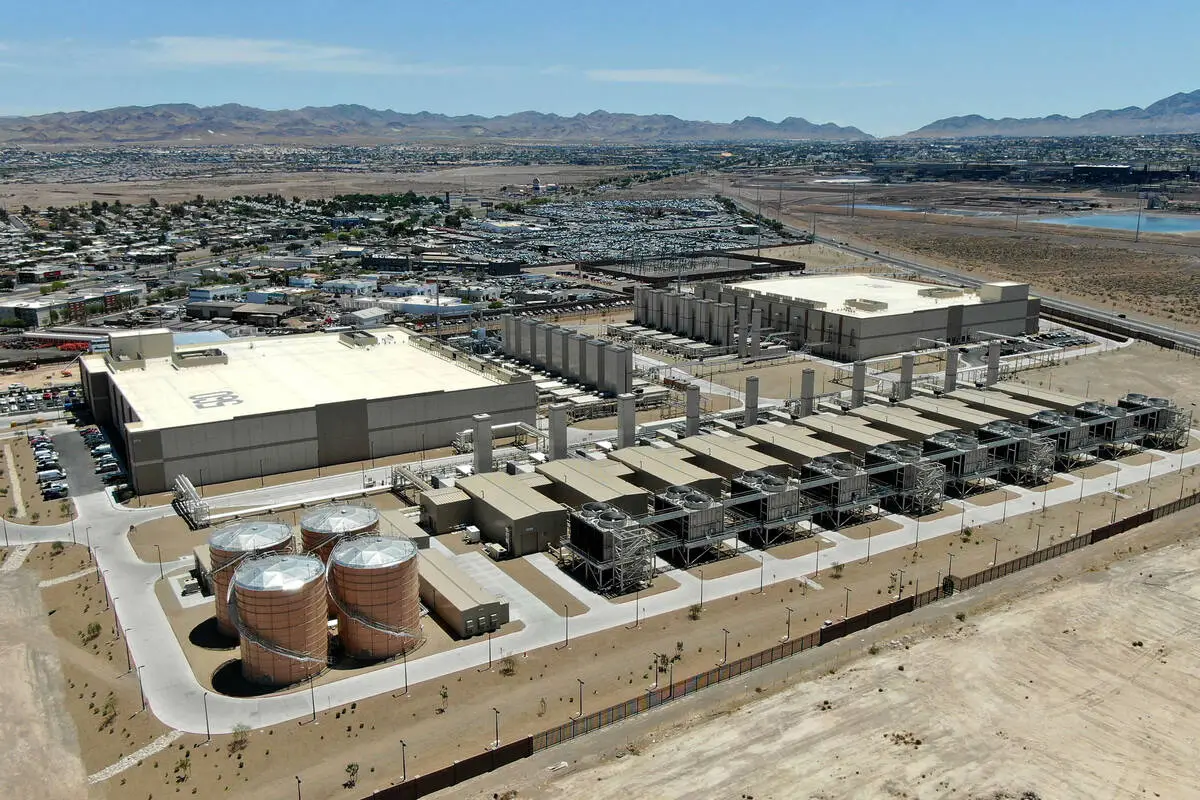
Henderson’s Google data center is expanding fast. That growth brings economic benefits, but it also raises a question Nevada can’t ignore in a desert state: how much water and electricity does a hyperscale facility like this consume?
Google’s campus sits on about 64 acres in Henderson’s industrial area. The site opened in 2020 after a large first phase and has received $400 million in upgrades and expansion. That investment is tied to rising demand for Google Cloud products and AI computing, which require huge server fleets running nonstop.
Facilities of this size generate intense heat. Cooling that heat has been one of the biggest water issues linked to data centers in the Southwest. In 2024, estimates compiled from local jurisdictions and reported by the Review-Journal show the Henderson Google data center as the largest known data-center water user in Southern Nevada, at roughly 352 million gallons for the year. That works out to around 963,000 gallons per day on average. It’s a scale that matters in a region where every acre-foot is debated, especially during hotter summers and ongoing drought pressure on the Colorado River system.
Electricity demand is just as significant. Public planning and engineering records associated with the Henderson build describe a major data center of roughly 300,000 square feet designed for about 60 megawatts of computing load in its early phase. Data centers also use power to run cooling systems and electrical infrastructure, so real draw is higher than the server load alone. Even using Google’s own efficiency standards, a 60-megawatt IT facility typically operates closer to the mid-60-megawatt range when overhead is included. Over the course of a year, that translates into hundreds of gigawatt-hours of electricity—roughly comparable to the annual consumption of a small city’s worth of homes.
Google has pursued renewable energy in Nevada, including major solar and geothermal arrangements, and says it aims to replenish more water than it consumes by 2030 through efficiency and restoration projects. Those steps help reduce long-term impact, but they don’t change the basic math of what it takes to run hyperscale computing in a water-scarce, power-constrained region today.
Henderson’s campus reflects a much bigger trend. AI systems and cloud services are pushing data center growth across the West, and these facilities are drawn to places like Nevada for land availability, business incentives, and grid access. The tradeoff is that the same places best positioned to host them are also the places where water and electricity are most limited.
For Nevada, the debate is shifting. It’s no longer about whether the state can attract data centers. It’s about how to manage them responsibly. That means clear public reporting on utility use, strong recycling and cooling requirements, and realistic planning for the power generation and transmission these campuses will require as they expand. The Henderson Google site makes the issue concrete: high-tech growth in the desert is possible, but it comes with real resource costs that need to be faced openly.