
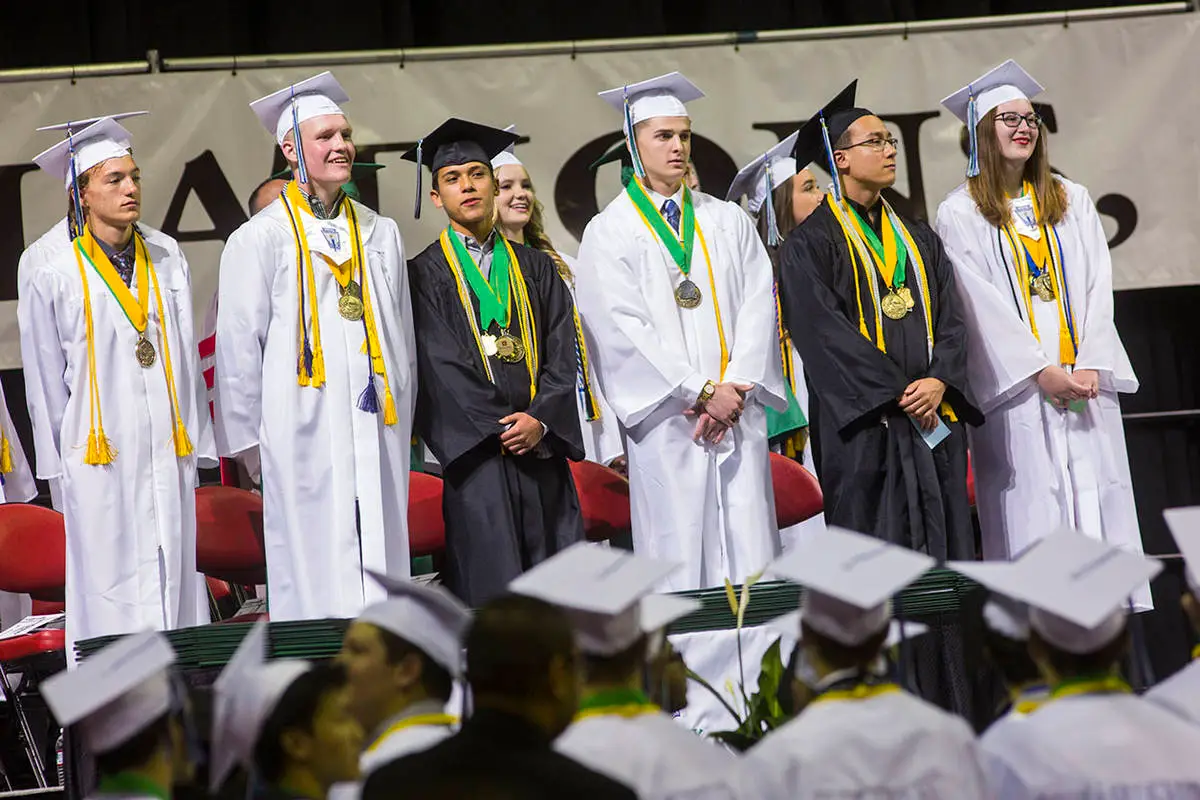
Clark County School District’s newly released graduation figures show real momentum districtwide and Henderson schools are a big part of that story.
CCSD’s graduation surge sets a new pace
At a November 2025 briefing, CCSD Superintendent Jhone Ebert announced that the district’s four-year graduation rate climbed to 86.6% for the Class of 2025, up from 81.5% for the Class of 2024 — a five-point jump in a single year.
The statewide rate rose too, reaching 85.4%, but CCSD’s improvement outpaced the state’s year-to-year growth.
District leaders credited a mix of stronger instructional materials, professional development, and expanded career-and-technical pathways. Ebert also emphasized that improved graduation numbers translate directly into higher access to college, training programs, and stable employment for students across Southern Nevada.
What this means for Henderson
Henderson sits inside CCSD, so the city benefits from the districtwide rise but local data show Henderson schools already graduating students at rates above both the district and Nevada averages.
Across Henderson public high schools, the graduation rate is estimated around 93%, noticeably higher than CCSD’s 86.6% and Nevada’s 85.4%.
That citywide strength reflects performance at several large comprehensive campuses, plus high-performing charter and dual-credit options.
Graduation rates at major Henderson high schools
Below are the most recently reported four-year graduation rates available from school performance summaries:
- Green Valley High School: 95% graduation rate.
- Foothill High School: 94% graduation rate.
- Liberty High School: 93% graduation rate.
- Coronado High School: 91% graduation rate.
These numbers indicate that Henderson’s core CCSD campuses are not only keeping pace with the district’s rise, but in several cases exceeding the new CCSD average by 4–9 points.
Academic proficiency: a mixed but improving picture
Graduation gains matter most when paired with solid academic readiness. Henderson campuses show a wide spread in proficiency, with some schools outperforming state averages and others still working to rebuild foundational skills.
Recent proficiency snapshots show:
- Coronado High School: about 43% proficient in math and 69% in reading — well above Nevada averages.
- Foothill High School: about 28% proficient in math and 59% in reading; reading is notably strong relative to the state.
- Green Valley High School: about 19% proficient in math and 51% in reading, pointing to stronger literacy than math.
- Liberty High School: about 18% proficient in math and 48% in reading, close to state reading levels but still low in math.
- Basic Academy of International Studies: a tougher profile, with roughly 8% proficient in math and 27% in reading, and graduation rates historically in the low-80% range.
Citywide, Henderson high schools average higher math and reading proficiency than Nevada overall (about 38% math and 57% reading compared with 25% and 46% statewide).
So while some campuses remain far below the city’s top performers, Henderson as a whole is trending ahead of the state on achievement.
Why Henderson’s results stand out
A few local factors help explain Henderson’s comparatively strong graduation outcomes:
- Concentration of high-performing options. Henderson hosts some of Nevada’s top-ranked public and charter high schools, including specialty and dual-credit programs that are boosting completion and college readiness.
- Strong literacy performance. Even schools with weaker math proficiency often post reading results above statewide averages, supporting on-time graduation through ELA course completion.
- Career and technical pipelines. CCSD’s districtwide push for CTE aligns with Henderson’s campus offerings, helping students stay engaged and finish with industry credentials alongside diplomas.
The remaining challenge: turning diplomas into mastery
The district’s 2025 graduation rise is worth celebrating, but the Henderson data underline the next step: closing proficiency gaps, especially in math. Nevada’s own report card shows that statewide proficiency still sits below the halfway mark in many tested areas.